Without seeing the dog and the behaviour first hand its difficult to say what is going on as others have said, there certainly seems to be an element of confusion over the exercise but the barking and charging into you could be excitement... just wondering two things....when you normally reward/praise him does he get excited, jump up, or bark? Also when you recall, do you use the arms wide open out to the side signal? I'm just wondering if he could be getting confused with your out-stretched arm signal and misinterpreting it as a recall where he would charge towards you and get excited??
I see where Farmboy is coming from, but unless this barking is prevalent elsewhere in your training, I would be more inclined to say that as the dog gains understanding and confidence in the exercise I would imagine the barking would more than likely cease.
Wendy
teaching left & right / direction
Re: teaching left & right / direction
Adding to Wendy's question above, when you give your direction command do you start with your hand above your head and sweep it down, to the left/right or do you have your hands down by your side and sweep it up, to the left/right.
I always give a sit whistle with my hand above my head as if I was giving the command at a distance and then direct as required.
I always give a sit whistle with my hand above my head as if I was giving the command at a distance and then direct as required.
-
cornishbirdabroad
- Member
- Posts: 195
- Joined: Mon Jun 08, 2009 8:54 pm
- Dogs: Herbie
- Location: Somerset
Re: teaching left & right / direction
Thanks everyone for the replies especially the detailed info re clicker training left and right. I will speak to my trainer about this minor difficulty and refrain from doing the exercise until our next lesson so she can witness what happens.
I'm just confused myself as in our lessons he doesn't bark nor has he in our training sessions by ourselves so I was a bit flabbergasted when he started today.
In answer to praising him he doesn't jump up or bark at me just wags his tail furiously whilst getting the fuss. When we learned recall at puppy class we were taught to have our arms outstretched but I long gave up as Herbie has always raced back to me with just a whistle. But it's still a consideration. He doesn't bark elsewhere in our training sessions just here on this excercise, so I'm thinking having read everything here maybe somehow I've confused the issue along with him being excited etc about what we're doing or it's an avoidance tactic as both the trainer and I have noticed he does really well at the areas he's interested in.Wendy M wrote:Without seeing the dog and the behaviour first hand its difficult to say what is going on as others have said, there certainly seems to be an element of confusion over the exercise but the barking and charging into you could be excitement... just wondering two things....when you normally reward/praise him does he get excited, jump up, or bark? Also when you recall, do you use the arms wide open out to the side signal? I'm just wondering if he could be getting confused with your out-stretched arm signal and misinterpreting it as a recall where he would charge towards you and get excited??
I see where Farmboy is coming from, but unless this barking is prevalent elsewhere in your training, I would be more inclined to say that as the dog gains understanding and confidence in the exercise I would imagine the barking would more than likely cease.
Wendy
crackerd wrote:Can't discern why the dog's barking at you, or "charging" you, but it sounds to be in part as wullie noted confusion, but more probability some sort of avoidance - that there's something else he'd rather be up to.MG
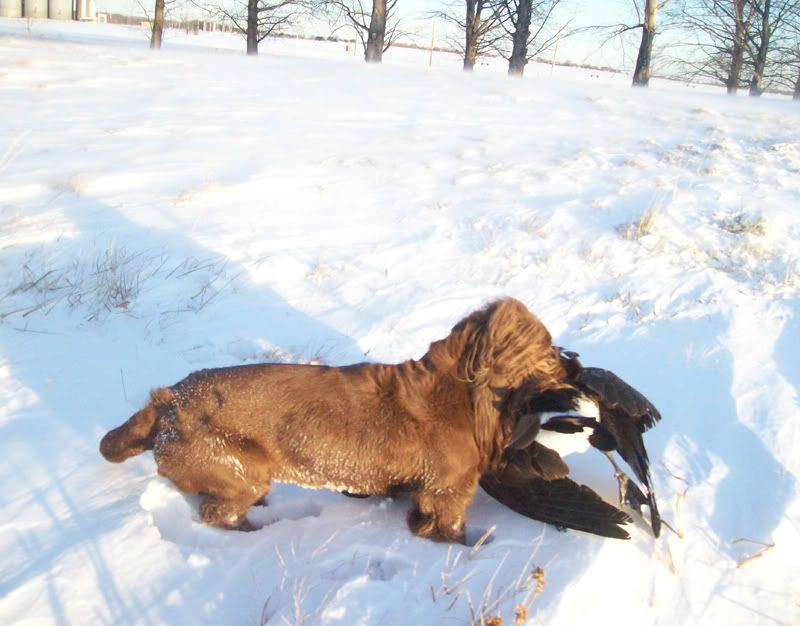
I can only go by how we have been shown, and I guess it's like everything in life you do some things in a certain way as that's the way you've been taught until someone says I've got a different method that might work just as well.crackerd wrote:Cornishbird (or Cornish game hen as our poultry industry might say), I'm sure your trainer knows best, but I would never teach directional casts this way of throwing the dummy then sending via hand signal. Why wouldn't you use instead the time-honoured idea of the "card trick" or three-handed casting as it's called hereabouts? For that, you could hup ol' Herbie (presumably a cocker from the photo?) then walk out and place the dummy/ies away from him (but always in plain sight), walk back to a position that's directly in front of him, then cast him to the dummy where you want him to go - right, left or straight back.
MG
I start with my hand above my head and sweep down to either the left or right.David wrote:....when you give your direction command do you start with your hand above your head and sweep it down, to the left/right or do you have your hands down by your side and sweep it up, to the left/right.
I always give a sit whistle with my hand above my head as if I was giving the command at a distance and then direct as required.
I'm just confused myself as in our lessons he doesn't bark nor has he in our training sessions by ourselves so I was a bit flabbergasted when he started today.

The Squirt
Re: teaching left & right / direction
Couple of things I have seen; some people put their right hand up vertically then swing it slightly to the left before bringing it right over to the horizontal, and vice versa with the left arm. I think they relax the elbow slightly before swinging the arm.
The other thing, some folks do is swing the arm out sideways and lean the body slightly to make an obvious indication, great, but then bring the opposite arm out slightly to counterbalance themselves.
Both of these little foibles can be extremely confusing to an observant dog. In the first case a keen dog may go with the first movement rather than the big, intended, direction signal. In the second the dog sees both arms out and comes towards you or makes a random guess as to which way to go.
And the back arm signal is a whole new ball game! If the dummy is slightly to the right of the dog, signal back with your right arm, if its to the left, signal back with your left arm and, in either case, bring your arm down in a straight line in front of you, not slightly off to one side like a lot of people do, your dog might just take you literally and go off on a diagonal!
Just things to bear in mind CBA, you might not be doing any of them but your trainer should spot it if you are.
The other thing, some folks do is swing the arm out sideways and lean the body slightly to make an obvious indication, great, but then bring the opposite arm out slightly to counterbalance themselves.
Both of these little foibles can be extremely confusing to an observant dog.
In the first case a keen dog may go with the first movement rather than the big, intended, direction signal. In the second the dog sees both arms out and comes towards you or makes a random guess as to which way to go. And the back arm signal is a whole new ball game! If the dummy is slightly to the right of the dog, signal back with your right arm, if its to the left, signal back with your left arm and, in either case, bring your arm down in a straight line in front of you, not slightly off to one side like a lot of people do, your dog might just take you literally and go off on a diagonal!
Just things to bear in mind CBA, you might not be doing any of them but your trainer should spot it if you are.
In life, it is important to know when to stop arguing with people and simply let them be wrong.
Re: teaching left & right / direction
If you never fed Herbie for a day!!!? 
 ...
Sat him up in front of you, with your hand raised (like you say), and in that hand, you had a big juicy bone ?...would he sit?...
and if you threw that big juicy bone, to the right of Herbie, would he come running in to you barking?
...Sat him up in front of you, with your hand raised (like you say), and in that hand, you had a big juicy bone ?...would he sit?...
and if you threw that big juicy bone, to the right of Herbie, would he come running in to you barking?
Re: teaching left & right / direction
Robt., as always you simplify it for them what overfinks (and overdoes?) it with training. Coming feeding time, substitute the food bowl for your big juicy bone, set the bowl 20 feet away from the dog, stand directly in front of the dog, extend your arm in the direction of the food bowl and simultaneously give the verbal command you use for left or right, gee or haw, "thisaway" or "thataway."Polmaise wrote:If you never fed Herbie for a day!!!?
Sat him up in front of you, with your hand raised (like you say), and in that hand, you had a big juicy bone ?...would he sit?...
and if you threw that big juicy bone, to the right of Herbie, would he come running in to you barking?
cornishbird, this is simple casting, don't overcomplicate it (nor have your brain go overboard at it). Gundogs love to play casting games, that's why we're able to start them here at it @ 12-14 weeks old. Placeboards ("mats"), clickers, rewards, etc.? - extraneous; all you really need is a pup, a dog that will maintain eye contact with you whilst sitting and awaiting the command and/or your casting motion. If they can see the dummy - and it's advisable to use white or as close to white as your fabric models allow - they're all (99.9% of them) keen to get it. But if you insist on throwing the dummy and turning the casting drill into essentially a dog being handled to a marked retrieve, rather than walking it out and returning to face the dog, well, that can be cause of additional complications.
As for having the trainer appraise your casting style to see what you might be doing wrong (if anything), why not save a few bob and DIY it - no better place for self-assessment than in front of a mirror...
MG
Re: teaching left & right / direction
And if the dog doesn't do it?....Just say No!Judy wrote:Couple of things I have seen; some people put their right hand up vertically then swing it slightly to the left before bringing it right over to the horizontal, and vice versa with the left arm. I think they relax the elbow slightly before swinging the arm.
The other thing, some folks do is swing the arm out sideways and lean the body slightly to make an obvious indication, great, but then bring the opposite arm out slightly to counterbalance themselves.
Both of these little foibles can be extremely confusing to an observant dog.
And the back arm signal is a whole new ball game! If the dummy is slightly to the right of the dog, signal back with your right arm, if its to the left, signal back with your left arm and, in either case, bring your arm down in a straight line in front of you, not slightly off to one side like a lot of people do, your dog might just take you literally and go off on a diagonal!
Just things to bear in mind CBA, you might not be doing any of them but your trainer should spot it if you are.


Re: teaching left & right / direction
 Did you teach recall with your arms out to encourage the dog to you Brian
Study me as much as you like, you will never know me, for I differ a hundred ways from what you see me to be
-
cornishbirdabroad
- Member
- Posts: 195
- Joined: Mon Jun 08, 2009 8:54 pm
- Dogs: Herbie
- Location: Somerset
Re: teaching left & right / direction
The shock would be more Herbie's than mine! As he is so food orientated. But to answer your question Polmaise: no, if I had thrown a bone to the right etc etc he wouldn't run into me barking, he would be straight at the bone noshing.Polmaise wrote:If you never fed Herbie for a day!!!?
Sat him up in front of you, with your hand raised (like you say), and in that hand, you had a big juicy bone ?...would he sit?...
and if you threw that big juicy bone, to the right of Herbie, would he come running in to you barking?

Crackerd, I used the method you suggested this morning as I wanted to be clear in my own mind about what you described. And....
I had no barking / no running into me just a keen dog wanting to get the dummy and return it to me. All I can do is speak to my trainer on Friday at our lesson about the two methods and what has taken place during our training session yesterday and today and go from there.
Judy, thanks about the arm movement scenarios it did make think if I've been doing that. But I've been checking my arm movements in the mirror, and my arm is straight both in the up and out left / right movement. But of course when practising in front of a mirror it's going to be different to practising out in a windy/ wet field. So again another item for Friday's lesson for my trainer to check and anyone who's near me!!
I did when we were at puppy class, but I gave up doing so a long time ago as Herbie always comes back on a whistle.BLM wrote:
No is such an over-rated wordPolmaise wrote: And if the dog doesn't do it?....Just say No!
 Have to say though it's been a regular training word since the day we brought Herbie home with us.

The Squirt
Re: teaching left & right / direction
Glad to hear, cornishbird - method's been proven sound down the years, both here and on your side, and will try to explain how so and what for in a few words.cornishbirdabroad wrote: used the method suggested.... And....
I had no barking / no running into me just a keen dog wanting to get the dummy and return it to me.
Let's say you sit the dog and it watches whilst you walk dummies out at nine, 12 and three o'clock (for left, back and right casts). Now you walk back in and are vis-a-vis the dog. The dog has seen you put out three dummies - which one will you cast it for? That's what gets the dog's intense focus - on you. It cannae go for a dummy, and mustn't be allowed to, until you've given it a directional cast. This signifies the fundamental aspect of cooperation with a gundog in going for a blind retrieve - ironic, innit, as the dog can plainly see or has seen you "plant" all the dummies yet this is the rudimentary or ur-stage of handling for blinds.
When you're standing in front of the dog, you want to hold your hands in a prayer position, tight to your chest. As you give the particular cast, you extend the arm that goes with it, full extension, even exaggerated. You might even walk a step in that direction for more exaggeration to let the dog "know" what you want. (On the back cast, with arm - right or left - shot straight overhead, you want to step into the dog to help propel it back rather than perhaps wanting to go for an easier dummy on the right or left side. [For Judy: You can "just say no" if the dog goes for the incorrect dummy but don't "beat the dog up" verbally for doing so, just encourage "Let's try it again!" You may even have to walk another dummy out to the 12 o'clock position for emphasis before making your remedial cast.] But this is always meant to be a fun exercise and it's imperative to keep it that way - for both you and the dog.)
With each return, you can toss the dummy back to its original spot - but never send the dog back on the next cast for that particularly dummy. That way you keep the dog guessing - and keep its focus on you awaiting the cast you will give it. Trust in you, the handler, accumulates along with cooperation on each send. And the darnedest thing, in my experience, is that spaniels are more "honest" about learning and retaining it after they've been trained up than retrievers. Why so? Retrievers always want to take a back cast, throwing their go-power into high gear. They don't want to run laterally, they (at least "our" they) are hard-charging away. Spaniels in this one instance seem more obliging and surprise, willing to take a straight line "over" when given the apposite cast. Of course, it helps if some of them spaniels are long straight lines themselves to begin with...
Good luck going ahead with it,
MG