I think this is a very grey area, Pol, because, as you have pointed out, this can be a learned behaviour that was inadvertently encouraged/taught, so whether it was nurture or nature is often open to speculation. 'Noise' is an eliminating fault at field trials & it used to be popular consensus that you didn't breed from a 'noisy' dog. As a matter of policy I've always steered away from noisy pups & noisy dams.Polmaise wrote:Do you think this is linked directly to the sire and dam Naj, or is it likely to be further back in the pedigree, in your experience?Naj wrote: and it is highly likely that there is a genetic trigger to the problem.
Naj
Is there any way of possibly linking it with the genetic information we have at our disposal these days?
My own thoughts are that it is unlikely that we will ever find a gene labelled 'whining', per se, but this problem, where it clearly isn't down to a learned response, is due to a fundamental flaw in the pup's temperament, which could well have a genetic link. And if this 'flaw' didn't manifest itself in whining then it would show itself in some other way. 'Natural' whiners do so from the day that they are whelped to the day that they die. They often appear to be ill at ease & discontented in nature. In my experience

 , the first springer I ever owned was what I would consider to be a natural whiner. She was of indifferent breeding & I can't remember whether the dam whined or not - probably wouldn't have noticed at the time. Temperament wise she was a bit skittish & had a poor mouth. She wasn't one of the best examples of the breed! A decade later I had my first trials springer who won a novice & had a bagful of awards, but inexplicably begin to 'witter' when she was about 5 years old. She was a ferocious hunter with a volatile temperament and shortly after she began whining her previously excellent mouth broke down. Her dam & sire were both mute. I bred a litter off her before her whining showed itself & the dog I kept on for a couple of years didn't make a noise during that time but was equally volatile in temperament to the point of being hard-headed. More recently, I had a cocker that was mute while being hunted & shot over, but developed a witter when waiting for duck to flight. She was mute in kennel, which leads me to think that it was a learned behaviour, & her litter sister never made a sound whatever she was doing. My only other brush with a natural whiner, a GSP, is still sitting in the kennel at 10+ years of age. She came as a surprise gift so I didn't choose her nor did I get the chance to see the dam or litter mates, and to be honest she wasn't the type of pup that I would normally have been drawn to. She whines constantly whenever she is motionless, & will even do so when curled up on my wife's knee of an evening. She has an extremely independent temperament, was the first 'bolter' that I have come up against in 40 years, and has always bitten anything she gets in her mouth from day one. Over the last 10 years she has been kennelled alongside 3 cockers, a GSP & an Irish Setter, & none of them ever made a murmur.
 Erlandson once wrote that he believed some dogs whined because the 'sit' command hadn't been taught thoroughly enough, so although the dog went through the motions of sitting to command it wasn't mentally happy to be there & expressed its frustration by whining. I partly agree with this, but believe that some dogs are predisposed to whine, for whatever reasons, & this can be suppressed by a good handler, but sooner or later it will show itself. This may answer why some dogs that were considered to be mute are triggered into whining by being in close proximity to a Whiner, and this can happen at any age. It used to be common practice of some handlers to steer clear of whining dogs as a matter of good management. I have often wondered about the impact of learned behaviour at the litter stage from being in close proximity to a dam that was prone to whining, but you do get whiners from mute dams. Perhaps there may be other environmental triggers, or some breakdown/glitch in socialisation or lack of handling during a critical period at this important time that causes insecurity that shows itself in whining in some individuals. I believe that there is also research to show that nervous/jittery or aggressive dams tend to produce pups with similar 'qualities'. Some of this may be down to learned behaviour but I also think that it could have been caused pre-whelping, by the influence of hormones/chemical triggers on the foetus while in the womb.

Naj
Sorry if I've repeated myself.


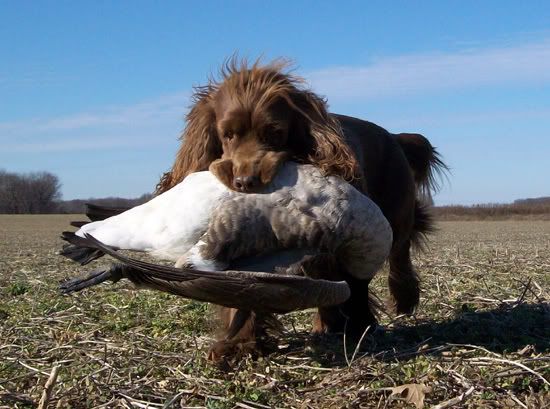
 with the 'stick it in yer gob'


 He still doesn't whine when training, the only time I get noise from him is if I've managed to confuse him by my requests, at which point he barks at me. But these days that's not often.

 but by the end of the training session he was noticeably quieter (still considerably worse than usual though!). I feel certain with him that he is very aware of what he is doing. He's a chatty dog and yesterday was furious with me for walking him away. When he finally got a retrieve (after a period of silence) he made his feelings extremely clear by behaving like an absolute ****
  Hey ho, we'll try the same thing again today and see if the penny starts to drop...maybe I'll stick a dummy in his mouth for the duration for extra measure...